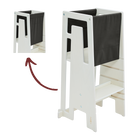
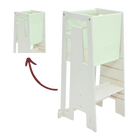
For many families, a Tuki Learning Tower is initially a helpful tool in the kitchen. But the Tuki® Learning Tower can do much more: it quickly becomes a permanent learning space at eye level. Children see more, understand connections better, and can often concentrate for longer when they don't have to watch "from below." A Learning Tower for children is therefore not only practical but also a real everyday boost for focus and independence.
Eye level changes attention
When children stand on the floor, they often only see the edge of a table or the worktop. In the Tuki® Learning Tower, they are at eye level. This has concrete advantages:
-
You can observe the processes involved (how to pour, stir, sort).
-
They understand processes (first prepare, then do, then clean up)
-
They are more likely to stick with it because they are actively involved.
A Tuki Learning Tower thus becomes a place where children are not just "present," but truly participate. This promotes concentration because the task is meaningful and tangible.
Concentration arises from active tasks.
Children rarely concentrate on simply watching for long. A Learning Tower helps them when they have a clear task. In the Tuki® Learning Tower, this could be, for example:
-
Wash the fruit and place it in a bowl.
-
Measure and prepare the ingredients
-
Stir or knead the dough
-
Sorting cutlery or stacking napkins
-
Place vegetables in a bowl (age-appropriate)
These activities are like little concentration games in real life. They also train motor development : grasping, dispensing, pouring, and precise placement.
The secure framework: Why stability creates focus
For a Learning Tower to function as a learning space for children , it needs a framework in which children feel safe. Uncertainty is distracting. That's why safety , children's safety , and stability are so important. A wooden Learning Tower must be firmly planted, not wobble, and remain stable even when moved.
Dimensional stability also plays a role here, especially in the kitchen (steam, splashes, cleaning). Those looking to buy a Learning Tower often ask: which wood should I use ? And also: why not solid wood ? The point is: solid wood can expand and contract (swell/shrink). The difference between veneer and solid wood can mean that, in practice, high-quality, dimensionally stable panel constructions remain more uniform in the long term, depending on their construction. The crucial point is: the construction must be stable, safe, and suitable for everyday use.
Practicality for everyday use: The learning space that requires no extra effort.
A learning space is only effective if it's used frequently. That's precisely why practicality is so important. The Tuki Learning Tower isn't just placed there "for learning"; it's simply part of the environment. Children climb up, help out briefly, stay for another two minutes to complete a small task, and learn almost without realizing it.
Typical learning moments in everyday life:
-
Sort colors and shapes (for example, fruit, lids, molds)
-
Count (number of berries, spoonfuls, pieces)
-
Language (naming ingredients, explaining steps)
-
Organizational systems (left/right, full/empty, large/small)
All of this happens because children at eye level have an overview and don't constantly fight for position or view.
Longevity and sustainability: When learning happens over years
A Tuki® Learning Tower is especially valuable when it remains in use for a long time. Durability means it withstands movement, remains stable, and is robust for everyday use. And that's precisely what sustainability is: a product that works for years instead of being quickly replaced.
Conclusion: Tuki Learning Tower as a learning space at eye level
A Tuki Learning Tower is a learning space because it brings children to eye level. This makes tasks visible, processes comprehensible, and participation possible. With its safety , stability , dimensional stability , and high everyday usability , it creates a place where children enjoy spending time and, incidentally, strengthen their motor development . If you want to buy a Learning Tower for children , it's worth considering these points, not just for the kitchen, but for everyday use.
Comparison & Classification:
Compared to well-known Learning Towers from tiSsi® , Ette Tete , Bianconiglio Kids, Pinolino , Fillikid and Childhome demonstrate how differently Learning Towers can be interpreted. While some models focus primarily on design or price, Tuki® places particular emphasis on a genuine Montessori Learning Tower that actively involves children in everyday family life.
The combination of stable wooden construction, well-thought-out height adjustability and high safety makes the Tuki® wooden Learning Tower a long-term and sustainable solution for many parents.