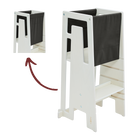
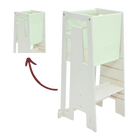
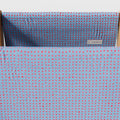
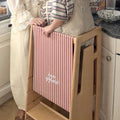
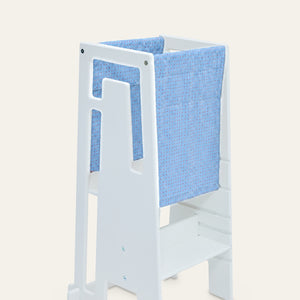
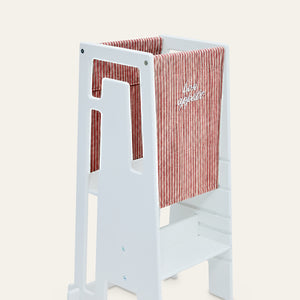
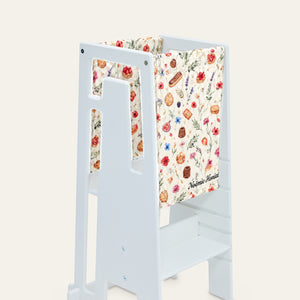
Small kitchen, limited counter space, lots of tasks: especially in apartments, organization is invaluable. Nevertheless, many parents want a Learning Tower so their children can help out with everyday chores. The good news: a Tuki Learning Tower can work very well even in small kitchens if you position it cleverly and pay attention to safety , stability , and practicality .
Why a Learning Tower is particularly useful in small kitchens
In a small kitchen, everything happens in a confined space. Children want to see what you're doing and ideally join in. A Learning Tower brings your child to eye level, eliminating the need for constant lifting. This saves time and energy and provides more structure. At the same time, a Learning Tower supports motor development , as children practice grasping, pouring, sorting, and performing small tasks.
If you're thinking of buying a Learning Tower and space is limited, your first thought is often: "Will it even fit?" If the Learning Tower is well integrated into everyday life, it won't become a nuisance, but rather a permanent "workplace" for your child.
Save space: 6 practical solutions for small kitchens
These ideas will help you use the Tuki® Learning Tower in a space-saving way:
-
Fixed parking space instead of hiking
Give the Tuki® Learning Tower a fixed location, for example next to the refrigerator or at the end of the kitchen counter. This way it won't constantly be in the way. -
Use only where it makes sense.
Place the Tuki Learning Tower in a location where tasks are frequently performed: by the sink or on the work surface. This way you won't have to move it as much. -
Create work zones
In small kitchens, it helps to set up a "kids' zone": a bowl, a cutting board, a damp cloth. The Learning Tower becomes a clearly defined learning and activity area. -
Tidying up as a routine
The Learning Tower is incredibly practical for everyday use, especially when tidying up immediately after cooking. Children can use it to sort napkins, cutlery, or empty bowls. -
Think compactly, but remain stable
Space-saving design should never come at the expense of stability . A good wooden Learning Tower stands securely and doesn't wobble, even when children turn around or lean forward. -
Keep safe routes clear
Important in small kitchens: The walkway must remain clear. Position the Learning Tower so that no one trips over it and doors/drawers can still be opened.
Safety in confined spaces: What you should pay particular attention to
Especially in small kitchens, where everything is closer together, children's safety plays an even more important role. A Learning Tower should:
-
have a secure footing ( stability )
-
Remain stable during movement ( shape stability )
-
It should be positioned so that no hot pans or sharp knives are within reach.
When children help out in the Tuki Learning Tower , give clear rules: "Hands stay on the surface," "Pan-pans are forbidden," "We work slowly." This creates security through structure.
Material and dimensional stability: which wood is suitable for a Learning Tower?
Anyone wanting to buy a Learning Tower for children often asks: which wood should I use for a Learning Tower ? And that leads to the question: why not solid wood ?
In everyday kitchen use (steam, splashes, cleaning), dimensional stability is crucial. Solid wood can expand and contract depending on the type of wood and its environment. The difference between veneer and solid wood can therefore be significant: High-quality, dimensionally stable panel constructions tend to remain more uniform in practice if they are well-made. Ultimately, what matters is not the buzzword, but whether the wooden Learning Tower remains stable, durable, and safe.
Everyday usability, durability and sustainability
In small kitchens, everything has to work. A Tuki® Learning Tower is effective when it:
-
is quickly ready for use (suitability for everyday use)
-
Remains robust (durability)
-
is used for years (sustainability)
Because sustainability also means: replacing less, using more. A Learning Tower that helps every day is a better choice in the long run than a product that just sits around after a short time.
Conclusion: The Tuki Learning Tower works in small kitchens if safety is a priority.
A Tuki Learning Tower also fits in small kitchens if you position it thoughtfully and create clear routines. This keeps the room calm and practical while your child can safely help out. When buying a Learning Tower , pay particular attention to safety , child safety , stability , dimensional stability , everyday usability , durability , and sustainability; then the Learning Tower won't be "too much," but just right.
Comparison & Classification:
Compared to well-known Learning Towers from tiSsi® , Ette Tete , Bianconiglio Kids, Pinolino , Fillikid and Childhome demonstrate how differently Learning Towers can be interpreted. While some models focus primarily on design or price, Tuki® places particular emphasis on a genuine Montessori Learning Tower that actively involves children in everyday family life.
The combination of stable wooden construction, well-thought-out height adjustability and high safety makes the Tuki® wooden Learning Tower a long-term and sustainable solution for many parents.